By Ira Dugal, Editor Financial News, with global Reuters staff
|
|
|
|
Geopolitical risks and supply-chain shocks are giving fresh urgency to India's drive for self-reliance. Can New Delhi's latest import-substitution push have an impact, considering the patchy record for past manufacturing campaigns? Write to me at ira.dugal@thomsonreuters.com.
And, protests by India's youth-led Cockroach Janta Party grow, posing the biggest public challenge to Prime Minister Narendra Modi in his third term. Read the latest on that story here and scroll down for more.
Also, a major ransomware group claims a leak of files related to the nation's largest nuclear plant. Catch that and other top Reuters stories on India in this week's must-reads.
|
|
|
Cutting external dependencies |
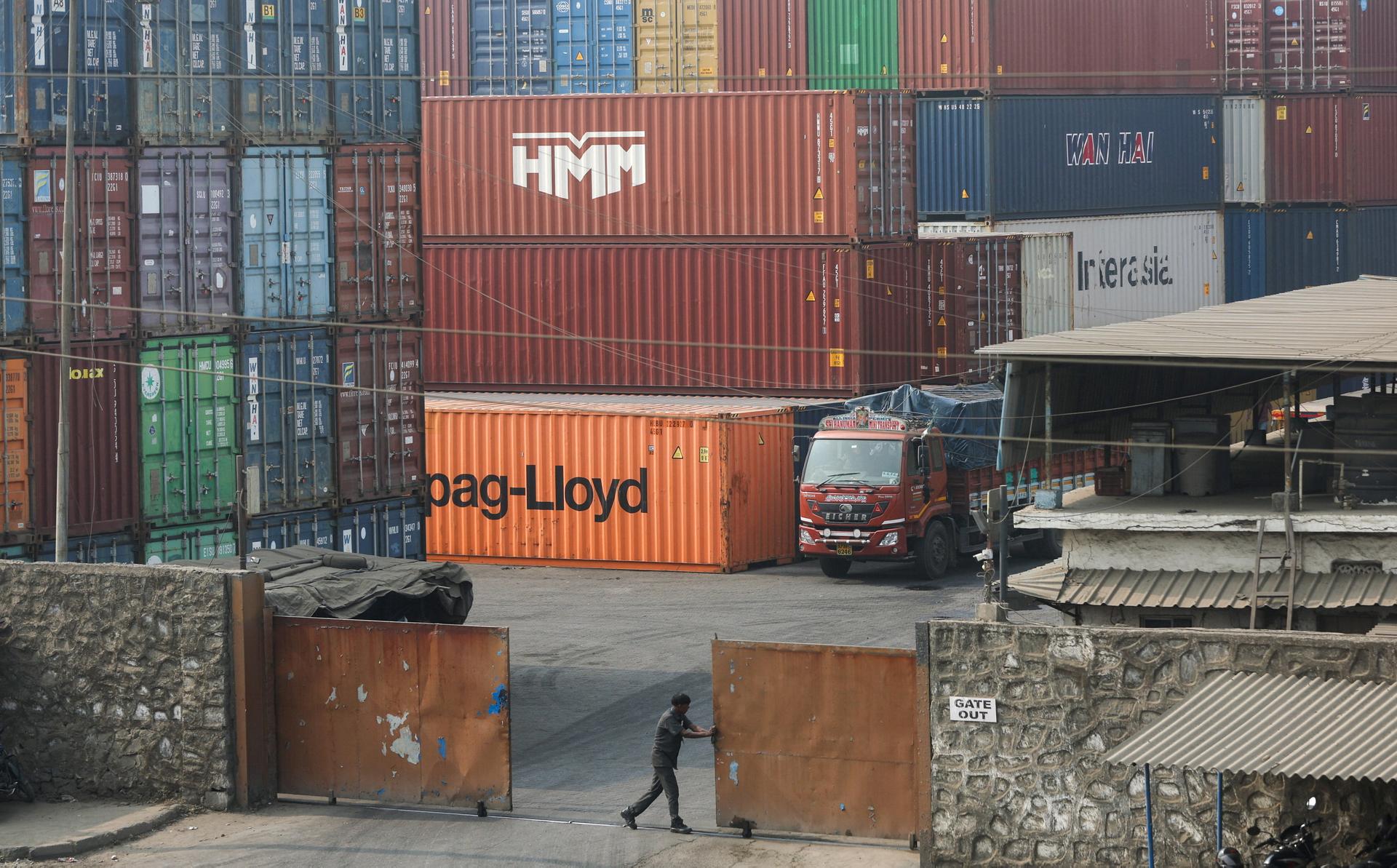
A man opens the gate of a shipping container yard in Navi Mumbai, India, February 4, 2026. REUTERS/Francis Mascarenhas
|
India is making another push to build more at home, as heightened geopolitical tensions and ongoing supply-chain disruptions reinforce the risks of relying on imports for critical goods.
New Delhi has identified products, accounting for roughly $51 billion of annual imports, for domestic manufacturing, Reuters' Nikunj Ohri and Shivangi Acharya reported.
The list spans sectors from textiles to renewable energy and is also aimed at reducing dependence on key suppliers, including neighbouring China. Read the full report here.
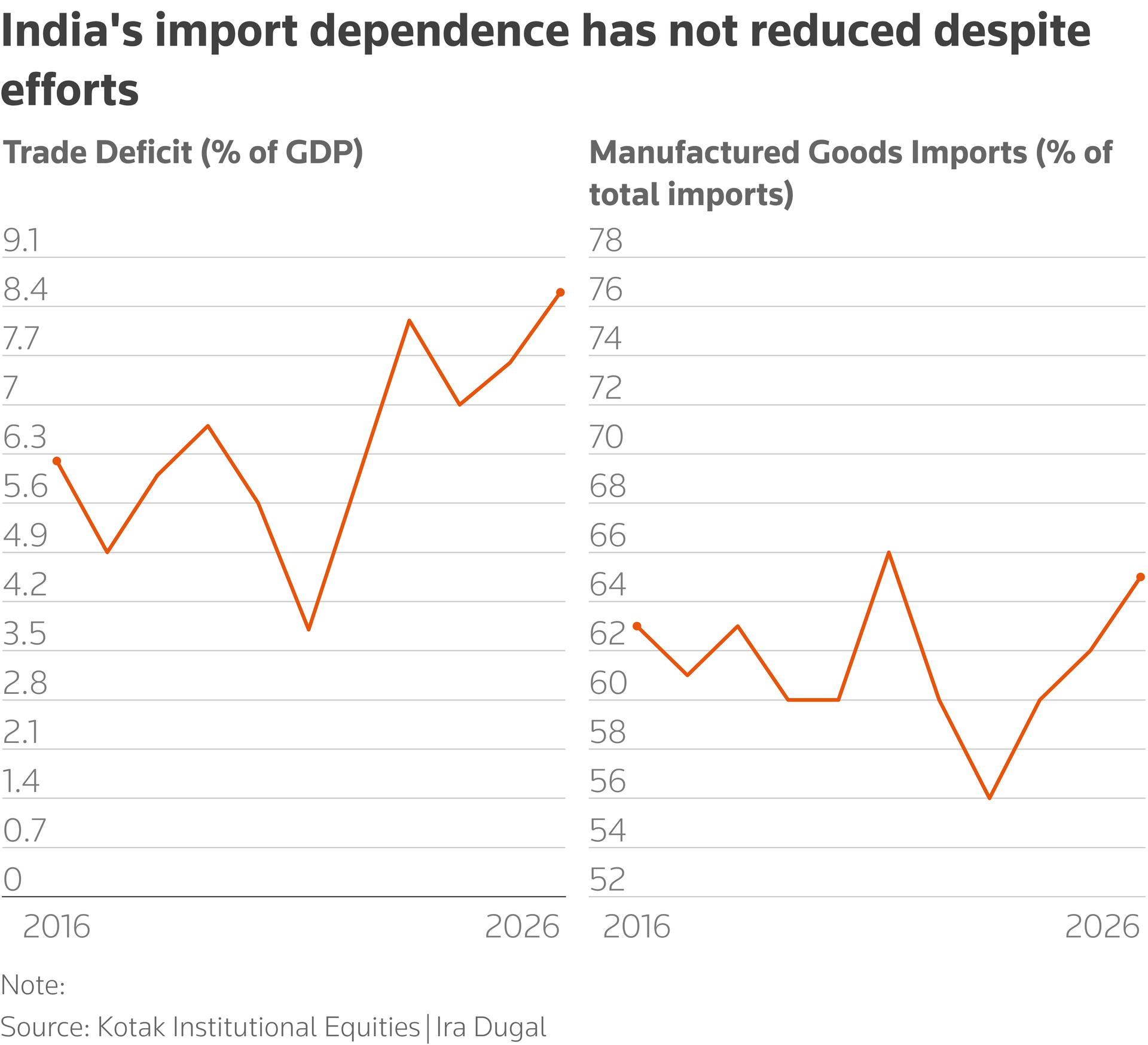
The effort reflects a broader challenge for India's economy. Expanding domestic manufacturing – whose share is currently at a low 13% of GDP – is seen as essential for creating jobs for a population of more than 1.4 billion, while also helping narrow a merchandise trade deficit that routinely exceeds $300 billion a year.
The latest initiative builds on a series of government programs designed to strengthen local industry.
Even before recent disruptions related to the Iran conflict, New Delhi had rolled out incentives for sectors such as semiconductors. Last week, it committed $13.3 billion for chip design, fabrication capacity and research. It also expanded support for mobile-phone manufacturing, adding $6.5 billion in fresh funding.
"Over the past 2 to 3 years, India's external dependencies have increased, driven by heightened geopolitical tensions and a global shift toward more isolationist capital, manufacturing and technology agendas," Kotak Institutional Equities said in a note last month.
"The option of imports is becoming narrower, which necessitates more radical policy actions to reduce external dependencies."
|
|
|
|
The ambition itself is not new. Prime Minister Narendra Modi launched the Make in India initiative in 2014, followed by the Atma Nirbhar Bharat (self-reliant India) campaign in 2020 and a series of production-linked incentive schemes aimed at boosting local manufacturing.
There have been notable successes. Apple and its suppliers have turned India into a growing export hub for smartphones, offering policymakers a template for what targeted incentives can achieve.
But outside of a handful of success stories, the impact has been mixed due to a myriad of factors from tough land and labour laws to complex import tariff structures and government red tape.
India remains exposed to supply disruptions and imported inflation, with dependence on some overseas inputs proving difficult to shake.
A study by Bank of Baroda economist Dipanwita Mazumdar found that import dependence among India's largest listed companies has remained broadly unchanged since fiscal 2019, averaging about 22.2%.
Resource-intensive industries such as industrial gases remain heavily reliant on imports, but dependence also persists in chemicals, shipbuilding, paper and electronics among others, Mazumdar's study found.
The challenge for policymakers is extending isolated achievements across a much broader swathe of the economy.
"We believe that it would be critical to replicate the success seen in mobile phones across more industries to drive import substitution," Kotak said.
The brokerage sees scope for reducing import dependence not only in high-tech sectors such as electronics, but also in labour-intensive industries including food products, footwear, furniture and textiles.
|
|
|
|
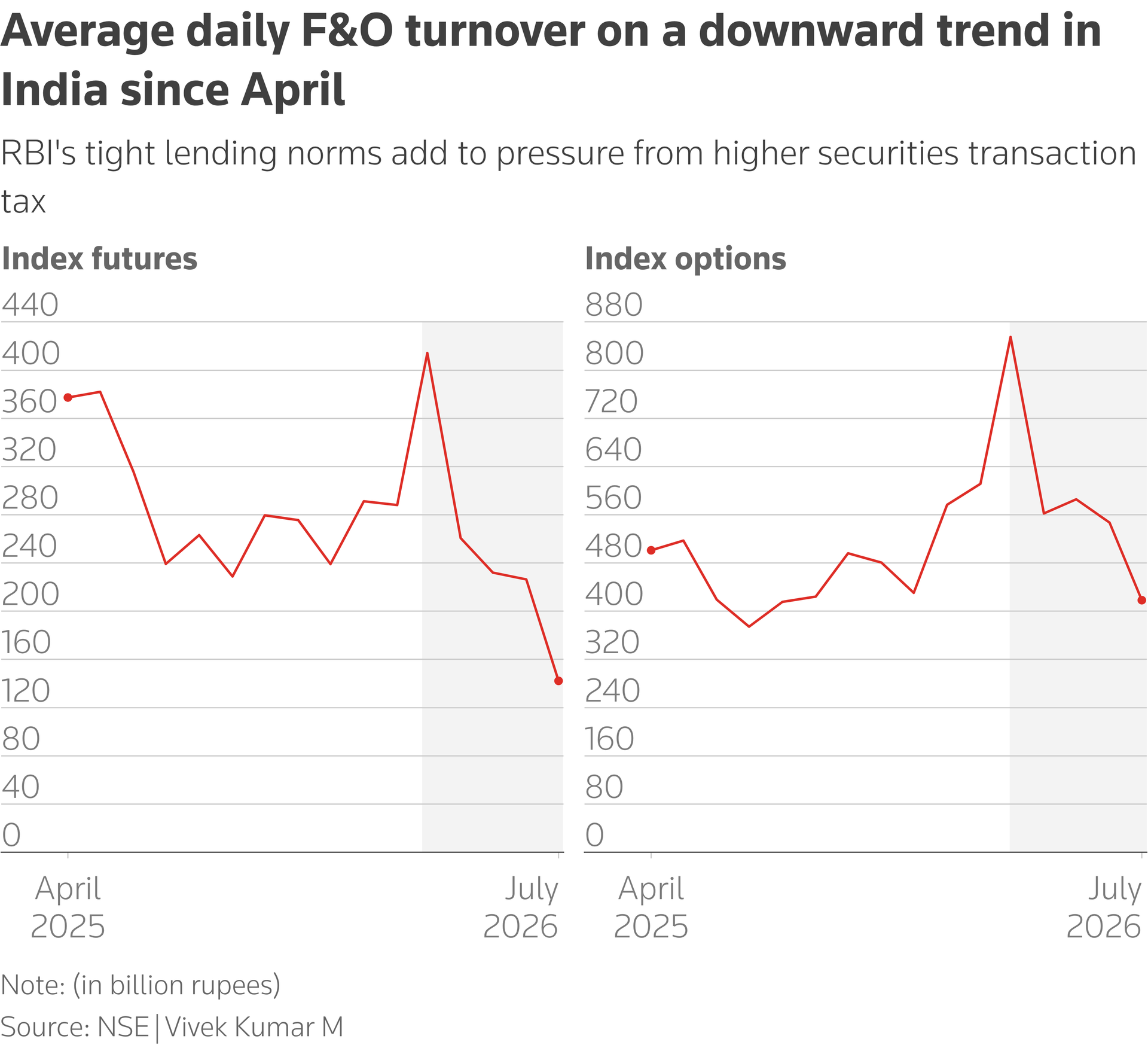
The average daily turnover in India's equity derivatives market has fallen by nearly a third in July so far, following funding restrictions placed by the central bank.
The Reserve Bank of India, effective July 1, barred banks from funding proprietary trading and required 100% collateral for other funding to brokers.
Read about the impact of those measures here.
|
|
|
|
- Maruti Suzuki, which has dominated India's car market for decades, is finding it hard to adapt its cost-focused culture to tastes of increasingly wealthy Indians, Aditi Shah reported.
- Ransomware group World Leaks has posted on the dark web a huge cache of files related to Kudankulam Nuclear Power Plant, the nation's largest, Munsif Vengattil and Aditya Kalra reported. The National Power Corporation of India said the information does not relate to any nuclear safety or nuclear security-related systems.
- Indian space startup Skyroot Aerospace launched the country's first privately developed orbital rocket, Nivedita Bhattacharjee and Gopika Gopakumar reported.
|
|
|
|
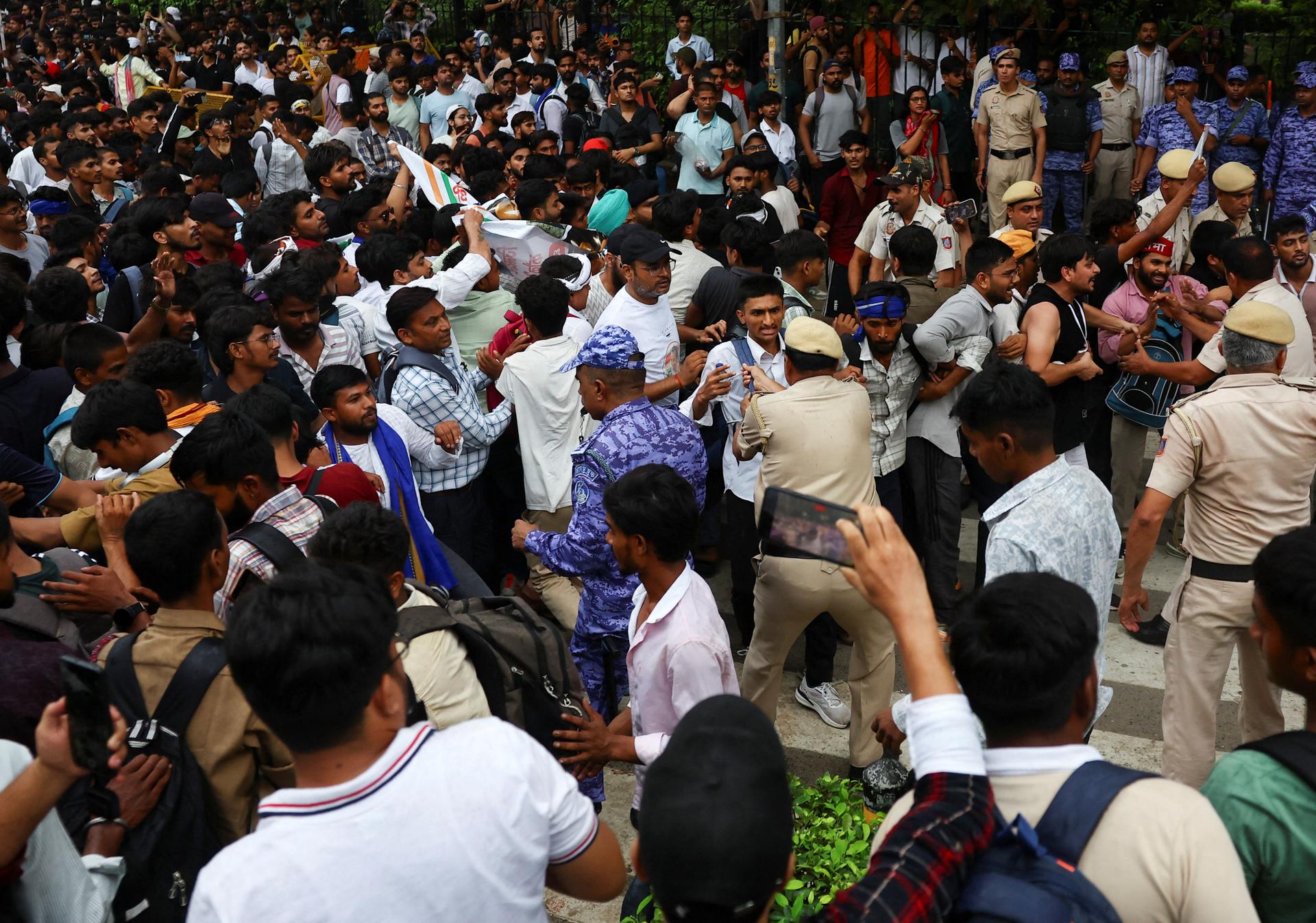
Police restrain people gathered near Jantar Mantar, ahead of a planned march to Parliament led by India's Cockroach Janta Party in New Delhi, India, July 20, 2026. REUTERS/Anushree Fadnavis
|
India's youth-led Cockroach Janta Party movement expanded its protests seeking accountability for a leak of exam papers, which could hurt thousands of students.
The protests gathered steam after a police decision to forcibly move hunger-striking activist Sonam Wangchuk to hospital on Saturday.
As thousands of protesters marched towards the Indian parliament, police forces had scatter them with tear gas and cane charges.
The three month-old movement and the protests are seen as the biggest public challenge to Prime Minister Narendra Modi in his third term.
|
|
|
|
This newsletter was edited by Kevin Buckland in Tokyo.
|
|
|
|
|
| |
|
|
Reuters India File is sent once a week. Think your friend or colleague should know about us? Forward this newsletter to them. They can also sign up here. Want to stop receiving this email? Unsubscribe here. To manage which newsletters you're signed up for, click here. This email includes limited tracking for Reuters to understand whether you’ve engaged with its contents. For more information on how we process your personal information and your rights, please see our Privacy Statement. Terms & Conditions |
|
| |
© 2026 Thomson Reuters. All rights reserved.
3 Times Square, New York, NY 10036 |
|
|
|
|
|






No comments:
Post a Comment