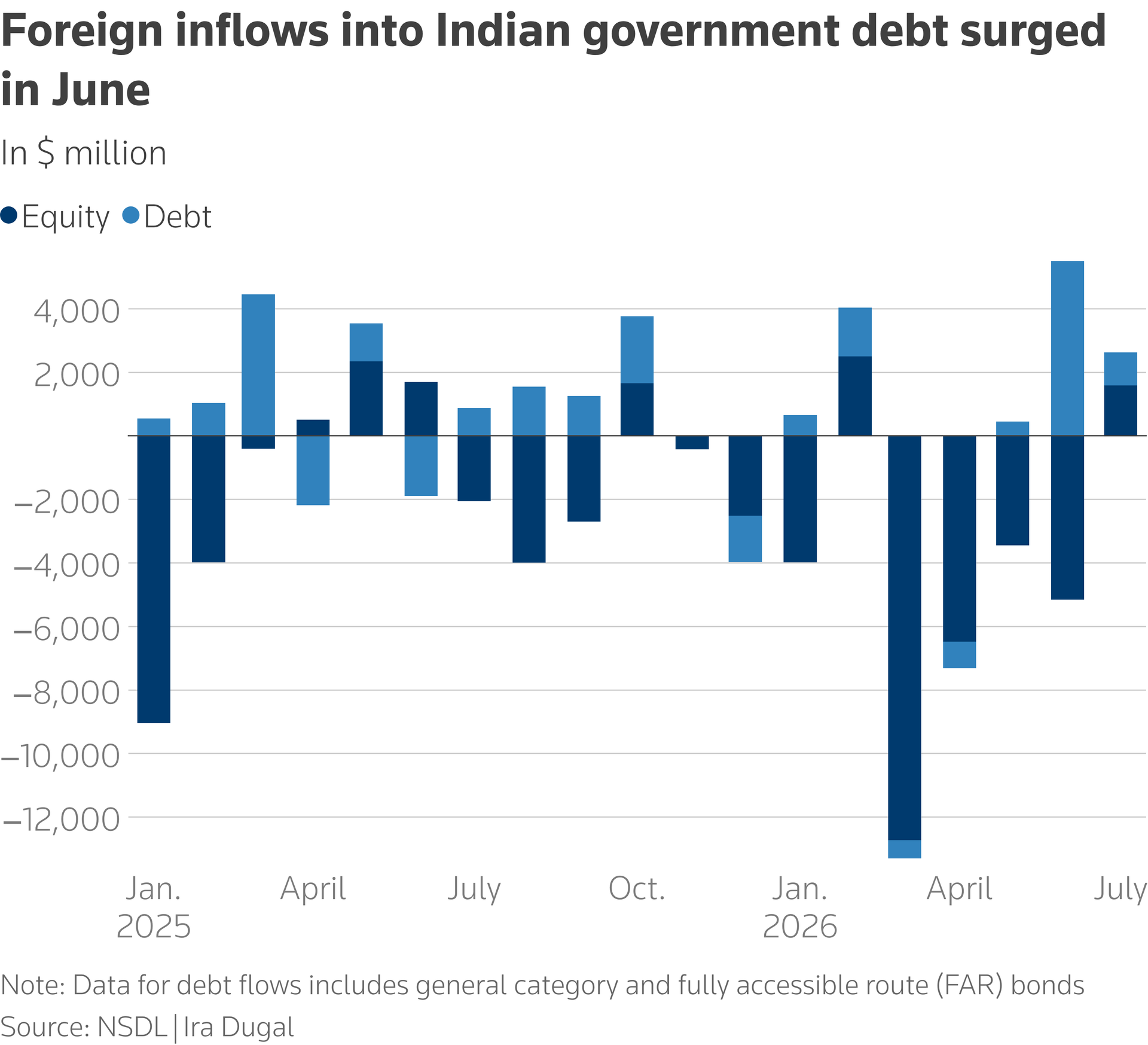
The inflows have given foreigners increasing clout in a market that the government historically has carefully controlled.
Overseas ownership of bonds in a category called "fully accessible route (FAR)" climbed to 7%, Reuters' Dharamraj Dhutia reported. FAR bonds, introduced in 2020, have no foreign investment restrictions and are now part of three global bond indices, buffing their attractiveness to foreign investors.
Prior to 2020, India had tightly limited overseas investment in government debt, even though equity markets were fully open. The worry was that foreign ownership might spur volatility in borrowing costs across the economy, acting as a constraint on policymakers.
For instance, bond vigilantes — investors who demand higher yields when they perceive fiscal risks — could complicate the pursuit of spending priorities such as strategic energy reserves. Yields rise when bonds sell off.
India could eventually become more susceptible to such pressures, but those risks remain limited for now, said Upadhyay.
"Foreign ownership of Indian government bonds is still low, while domestic banks and insurers continue to provide a stable source of demand because of regulatory requirements," he said.
Banks are required to hold 18% of their deposits in government bonds, while investment guidelines for insurance companies also require large holdings of these securities.
India's 7% foreign ownership is lower than countries like Malaysia and Indonesia, where overseas investors own about 22% and 14% of government debt, respectively.
And QuantEco's Kumar noted that much of the investment has come from funds tracking global bond indices, suggesting the inflows could prove sticky.
"These are largely passive investors and they typically don't swing positions very sharply due to near-term macroeconomic developments as their holdings are linked to an index weight," he said.








No comments:
Post a Comment