By Ira Dugal, Editor Financial News, with global Reuters staff |
|
|
Sumitomo Mitsui Banking Corporation's $1.58 billion deal for a 20% stake in Yes Bank, India's first big banking acquisition by a foreign investor in five years, looks set to reignite a debate about bank ownership in India. Is it time to consider easing regulations and allowing strategic investors more opportunities in Indian banking? That's our focus this week. And India starts drawing up plans on water supplies after it put the Indus Water Treaty with Pakistan in abeyance, as tensions heated up between the two countries. Scroll down for more on that. |
|
|
Getting to 'yes' on bank deals |
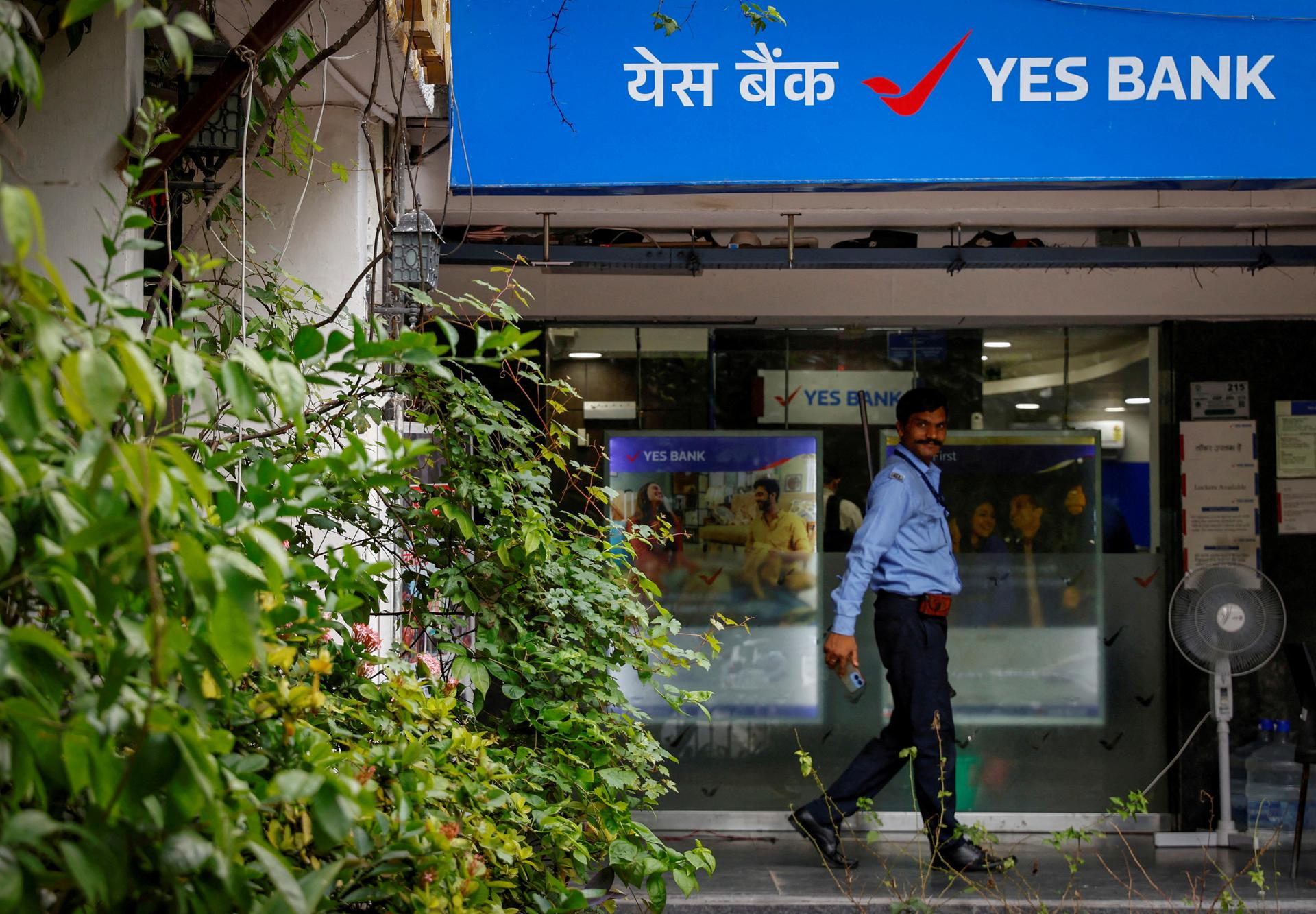
A private security guard stands outside a branch of Yes Bank in New Delhi, India, August 30, 2024. REUTERS/Ainnie Arif/File Photo |
It took more than a year to negotiate and the Japanese buyer ended up with less than half of what it wanted, but Sumitomo Mitsui Banking Corporation's deal to buy 20% of Yes Bank was still one for the record books - India's biggest bank deal to date with a foreign buyer. The $1.58 billion acquisition emerged from a clash of two formidable forces: the banking sector's drive to support the world's fastest-growing major economy, and the central bank's attachment to a stifling array of ownership restrictions. The deal is one of two big cross-border banking acquisitions expected this year, breaking a five-year drought while drawing attention to restrictions on foreign buyers, which may be depriving Indian banking of new sources of long-term capital and more diverse ownership. More than half of the banking system's assets are with government-owned institutions. The second deal, a plan to sell a majority stake in government-owned IDBI Bank, has been in the works for more than two years, while a broader plan to privatise at least a couple other government-owned banks has stalled. The need for capital is evident in India's credit-to-GDP ratio. At 90%, including credit from bank and non-bank lenders, it falls short of the 113% average among major economies, the Reserve Bank of India said in a December report. Strategic long-term investors, including foreign financial institutions, would be critical, analysts say, to mobilising banking sector support for rapid economic growth. The RBI, whose governor Sanjay Malhotra said earlier this year that India should aspire to annual growth of 7% or more, may be coming around to that point of view. "(The RBI) is slowly becoming more open to allowing regulated global financial institutions to own larger stakes, although this hasn't been codified in the regulations yet," said Abizer Diwanji, founder of NeoStrat Advisors LLP, a Mumbai-based consulting firm. |
|
|
The Reserve Bank of India has already in recent years grown more inclined to grant exceptions to a 15% limit on a single foreign financial institution's shareholding in an Indian bank, especially when a bailout of the target was needed. In the case of Yes Bank, shareholders that had been brought in to rescue the lender in 2020 needed an exit. DBS and Fairfax Holdings have also been allowed in past years to buy stakes in distressed lenders. But the RBI has held fast on other rules, such as a 26% limit on a foreign owner's voting rights. "The big hindrance still is the 26% voting cap and that may need to be revisited as it deters a lot of potential foreign buyers," NeoStrat Advisors' Diwanji said. RBI rules also require that a "promoter" - a regulatory classification in India for a large shareholder with influence over bank decisions - must reduce its equity holding to 26% within 15 years of acquiring its stake. Corporate ownership of banks is also barred in India. Globally, while most countries require well-diversified ownership of banks, far fewer have restrictions on voting rights and not all bar corporate ownership. India's plethora of rules has meant banking merger and acquisition deals are rare and often sub-optimal for both buyer and seller. For Yes Bank, Moody's Ratings said it would only factor in limited benefits from the SMBC deal, given the small influence afforded by a 20% stake, although it termed the transaction as "credit positive" for the Indian bank. The RBI last reviewed its rules in 2020, when it floated allowing corporations to own banks and making it easier for non-bank lenders to apply for a bank licence. But the final rules retained most of the existing restrictions while the pool of potential buyers, as evidenced by recent deals, has remained thin. Does India need to rethink bank ownership rules to give strategic investors more flexibility? Write to me at ira.dugal@thomsonreuters.com. |
|
|
After putting a decades-old water-sharing treaty with Pakistan in abeyance, India is expediting planning and execution of projects on the Chenab, Jhelum and Indus rivers. One plan under discussion would double to 120 km (75 miles) the length of a 19th-century canal on the Chenab, which runs through India to Pakistan's breadbasket of Punjab. Don't miss this Reuters exclusive. |
|
|
India's April foreign trade data, watched closely by markets for signs of front-loading of production during the 90-day pause in President Donald Trump's "reciprocal" tariffs, showed a 27% increase in exports to the U.S., with electronic goods up particularly sharply. Overall exports, though, rose a more modest 9% and the trade gap widened. Read here to understand the data. |
|
|
Cricket - Indian Premier League - IPL - Royal Challengers Bengaluru v Kolkata Knight Riders - M. Chinnaswamy Stadium, Bengaluru, India - May 17, 2025 General view inside the stadium as the match is delayed due to rain REUTERS/Stringer |
With the India-Pakistan conflict easing, the Indian Premier League cricket tournament restarted on May 17 to a rain-washed match. The IPL was suspended on May 9 with 12 matches left, as fighting escalated between the two countries. |
|
|
This newsletter was edited by Edmund Klamann, Deputy Head, Asia Desk in Singapore. |
Reuters India File is sent once a week. Think your friend or colleague should know about us? Forward this newsletter to them. They can also sign up here. Want to stop receiving this newsletter? Unsubscribe here. To manage which newsletters you're signed up for, click here. This email includes limited tracking for Reuters to understand whether you've engaged with its contents. For more information on how we process your personal information and your rights, please see our Privacy Statement. Terms & Conditions |
|
|
|







No comments:
Post a Comment