By YP Rajesh, South Asia Breaking News Editor & Lead Writer, with global Reuters staff |
|
|
Last week's deadly attack on tourists in Kashmir has rekindled worries over potential conflict in the region and served as a reminder of geopolitical risks for India - the world's most populous nation and its fastest-growing major economy - as well as for Pakistan. We take a look at those risks in this week's edition. And, some bright spots have begun to emerge from India's latest corporate earnings, after two quarters of disappointing results. Scroll down for more. |
|
|
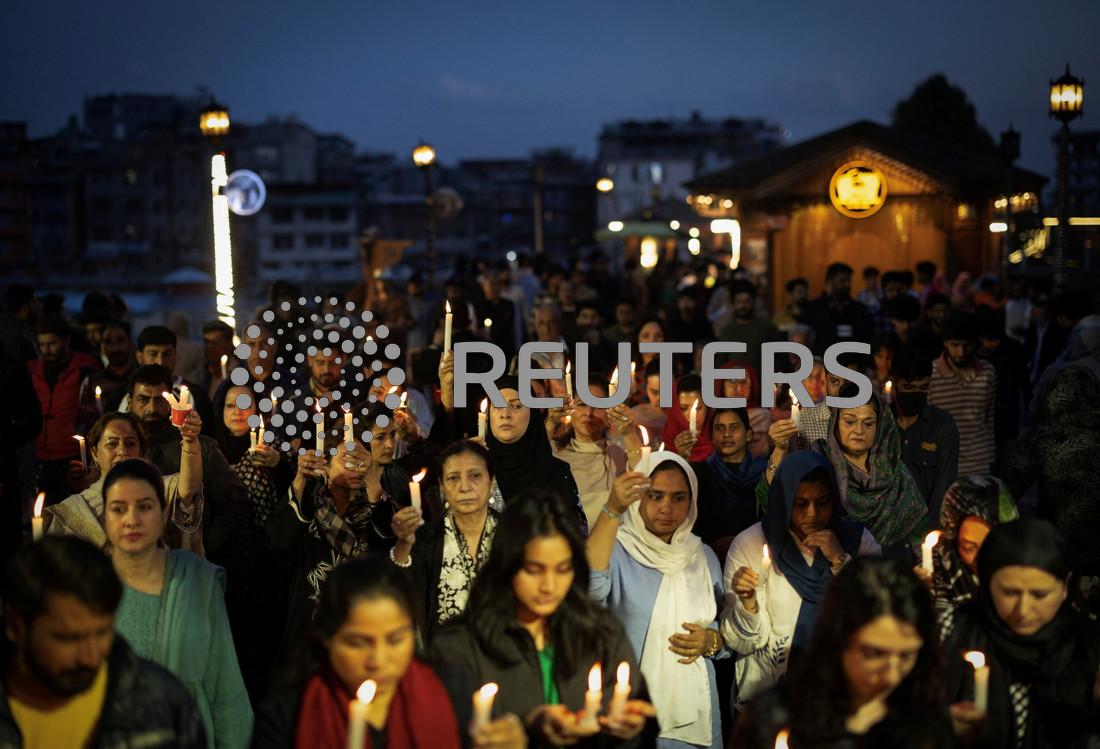
Demonstrators hold a candlelight vigil to mourn an attack on tourists near south Kashmir's scenic Pahalgam, in Srinagar, April 23, 2025. REUTERS/Adnan Abidi |
Deadly violence in Kashmir, escalating India-Pakistan tensions and the risk of armed conflict between two nuclear-armed nations: South Asia's nightmare scenario re-emerged last week when tourists taking in the pristine beauty of India's "mini-Switzerland" were attacked by gunmen. India charged that neighbouring Pakistan was behind the attack, which killed 26 men and was the worst against Indian civilians in 17 years. Pakistan has denied any role in the attack and called for a neutral probe. Both countries responded with a series of measures and countermeasures. India suspended a 65-year-old water supply agreement while Pakistan banned Indian airlines from its airspace. The risk of further escalation remains. Indian Prime Minister Narendra Modi pledged to pursue the attackers to the "ends of the earth" and Pakistan called the suspension of the water treaty an act of war, promising to respond with full force. Pakistan's defence minister also told Reuters that a military incursion by India was imminent. If past decades are any guide, the hostile manoeuvres and rhetoric will likely heat up for a few more months, after which both sides will slowly row back and return to some semblance of business as usual. But each episode of brinkmanship has left the relationship more fraught than before, and India's threat over the water treaty has added a new, more dangerous wrinkle. In the markets, the attack so far has only moderately darkened the mood for stocks and the currency, which had been a bright spot in recent weeks while other big global markets gyrated around U.S. tariff threats. For the two nations' economies, as well, the short-term damage may be limited. |
|
|
Pakistan's shutting off its airspace to Indian airlines could, of course, be a blow to Air India and IndiGo, adding to their fuel costs and journey times. The last such airspace ban, in 2019, cost Indian carriers at least $64 million over a five-month period, according to Indian government data - less than 1% of their combined revenue that year. Pakistan has also suspended all direct and indirect trade ties with India, although direct trade had already slowed to a trickle of just $1.2 billion in 2024. Indirect trade, through third countries, is estimated at $10 billion by the Global Trade Research Initiative, a New Delhi think tank. But that's still well below the $129 billion in trade with the U.S. threatened by President Donald Trump's proposed tariffs, and would be unlikely to ruffle many feathers given the much higher geopolitical stakes. "The ban on trade may affect some exporters, but in the current scenario, trading with or through a hostile country is not desirable," said Ajay Sahai, director general of the Federation of Indian Export Organisations. The damage looks much worse, however, for Kashmir, known for its scenic snow peaks, lush pine forests and Mughal-era gardens. In addition to the human toll and psychological shock to the region, there will be serious economic consequences. Hotels and lodges emptied within hours of the attack, airlines had to organise special flights for fleeing travellers, and tour operators were flooded with cancellations for the coming peak summer season. Kashmir, a flashpoint in relations between India and Pakistan that is divided between the two but claimed fully by both, had begun limping back from a decades-long anti-India insurgency and was witnessing a revival of mass tourism, especially after the COVID-19 pandemic. For a sector that contributes about 7% of the territory's GDP and directly employs about 200,000 people, the attack on the tourists could not have come at a worse time. "It's heartbreaking to see the exodus of our guests ... but at the same time we totally understand why people would want to leave," Jammu and Kashmir Chief Minister Omar Abdullah said. Does the violence in Kashmir threaten new, unprecedented levels of geopolitical risk for India and Pakistan? Write to me with your views at yp.rajesh@thomsonreuters.com |
|
|
South Korea's LG and Samsung have sued India's government to quash a policy that increases payouts to electronic-waste recyclers, joining other major companies in contesting the country's environmental rules. The lawsuits mark a deepening standoff between foreign companies and Prime Minister Narendra Modi's government over waste management practices and related business costs. Don't miss this exclusive report about India's struggle to manage its e-waste by bringing more formal players into the sector and boosting investment in recycling. |
|
|
After two consecutive quarters of disappointing corporate earnings, some large Indian firms showed an improved performance in the January-March quarter. Reliance Industries, owned by billionaire Mukesh Ambani, reported a stronger-than-expected quarter, sparking a 5% surge in its stock price on Monday. That helped to power gains in India's benchmark Nifty index, where Reliance is the third most-heavily weighted stock. India's big banks had already reported strong earnings for the quarter, boosting the stock prices of financial firms. Top consumer firms such as Hindustan Unilever and Nestle, though, have continued to report sluggish earnings on tepid demand from urban consumers and pressures on margins. |
|
|
Garbage is burnt at a dump alongside a road in the town of Byrnihat, ranked world's most polluted metropolitan area by Swiss Group IQAir, in India, March 29, 2025. REUTERS/Sahiba Chawdhary |
Many residents of Byrnihat, an industrial town on the border of northeastern India's Assam and Meghalaya states, suffer from illnesses that doctors say are likely linked to high exposure to pollution. Critics say Byrnihat's situation reflects a broader trend of pollution plaguing not just India's cities, including the capital Delhi, but also its smaller towns as breakneck industrialisation erodes environmental safeguards. And unlike other parts of the country that face pollution every winter, the air quality of Byrnihat - in an area otherwise known for its lush, natural beauty - remains poor through the year, government data indicates. |
|
|
This newsletter was edited by Edmund Klamann, Deputy Head, Asia Desk in Singapore. |
Reuters India File is sent once a week. Think your friend or colleague should know about us? Forward this newsletter to them. They can also sign up here. Want to stop receiving this newsletter? Unsubscribe here. To manage which newsletters you're signed up for, click here. This email includes limited tracking for Reuters to understand whether you've engaged with its contents. For more information on how we process your personal information and your rights, please see our Privacy Statement. Terms & Conditions |
|
|
|







No comments:
Post a Comment